Uncomfortable reading or screens.
Blur, tired eyes, or difficulty sustaining comfortable near work may be reasons to discuss your visual function with an eye-care provider.
Personalized assessment and doctor-supervised vision therapy for children and adults in Regina, Saskatchewan.
Whether reading feels uncomfortable, your eyes struggle to work together, or visual tasks have become difficult after an injury, we start by understanding your concerns.

Vision therapy uses a planned sequence of visual activities to work on specific visual skills under an optometrist’s supervision.
The assessment looks at how your visual system functions during everyday tasks. Skills we consider include focusing, using both eyes together, and moving the eyes accurately.
The approach depends on the condition and the individual. An assessment helps us decide whether therapy, another option, or further investigation is the appropriate next step.
These concerns can have different causes. Tell us about your symptoms so we can help you arrange an appropriate assessment.
Blur, tired eyes, or difficulty sustaining comfortable near work may be reasons to discuss your visual function with an eye-care provider.
We assess concerns involving eye alignment and binocular vision, including convergence insufficiency, amblyopia, and strabismus, to explore suitable care options.
Tell us about visual difficulties affecting schoolwork, work tasks, or life after a concussion or brain injury. Assessment findings guide any recommendations.

If your child finds reading or close work uncomfortable, an assessment can explore whether a visual difficulty is contributing.
Bring examples of the tasks your child finds difficult and any relevant eye-care or treatment history. We discuss the findings with you and explain whether there is a visual problem to address.
For example, convergence insufficiency affects how the eyes work together at near. Appropriate treatment can address the diagnosed visual difficulty. Vision therapy does not treat dyslexia or guarantee better school performance.
Our vision therapy team includes Justine and Danica, who bring encouragement and a personal connection to working with young patients.
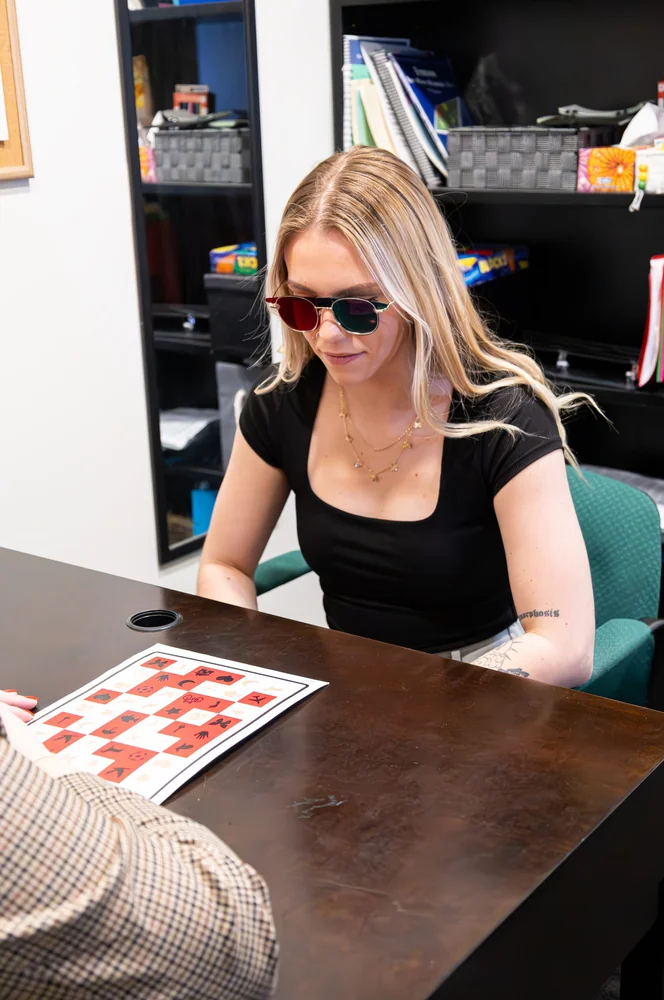
Vision therapy assessment is available for adults as well as children.
We discuss difficulties with reading, screens, focusing, or binocular vision in the context of your eye-care history and daily activities. If you have amblyopia or strabismus, we consider your history and findings when explaining options and realistic goals.
If symptoms began after concussion or brain injury, let us know about the injury and any other providers involved. Visual assessment is considered alongside your broader care; a therapy program is recommended only when appropriate.
We also welcome questions about sports vision training and the visual skills involved in athletic performance.
You do not need to commit to therapy to ask questions or arrange an assessment.
Call 306-559-9909. Tell us what you or your child are experiencing, and ask about arranging a vision therapy assessment.
We review your concerns and history and assess relevant visual skills. The findings help us understand the problem and discuss suitable options.
If therapy is recommended, we discuss the proposed activities, goals, schedule, fees, and how progress will be reviewed.
Bring your current glasses and information about relevant eye-care history or treatment. When you call, ask whether our team needs any records or forms before your visit.
There is no single schedule for every patient. The proposed program depends on the assessment findings, the condition, and your goals. We explain the recommendation before you decide whether to proceed.
Call our team for current assessment fees and questions about therapy costs or insurance documentation. Coverage depends on your own plan; confirm the details with your insurer.
No. An assessment helps identify the visual concern and appropriate next steps. The recommendation may involve therapy, another approach, or further evaluation.
Our Referring Providers page explains useful referral details. Call the clinic to confirm the appropriate submission method before sending patient information.
For general information, see the National Eye Institute’s guide to convergence insufficiency and the Canadian Association of Optometrists’ vision therapy position statement.
Call our team to discuss an assessment for yourself or your child.
Call 306-559-9909 ↗